

Flying After Diving: How to Plan Your Bali Holiday Around It
The rule itself is short: after a day of diving, wait at least 18 hours before you fly. What catches people out in Bali is everything around it, such as a 1 am flight that really belongs to the night before, or a sunrise trek up Mount Batur the morning after two dives.
This guide shows how to work back from your departure time, which Bali day trips count as going to altitude, and two sample itineraries you can adapt.
Allow at least 18 hours between the end of your last dive and your flight. DAN’s minimum is 12 hours for a single dive, but every day trip we run includes two or three dives, so 18 hours is the figure that applies. The same wait applies before you drive up to Kintamani, Bedugul or Mount Batur.
How the No-Fly Time Works
During a dive, your body takes up extra nitrogen, and it leaves gradually after you surface. An aircraft cabin is not kept at sea-level pressure; the flying after diving guidelines cover cabin altitudes of up to about 2,400 metres. Fly too soon and the pressure around you drops while that nitrogen is still leaving, which raises the risk of decompression sickness (DCS).
The minimum waiting times most divers follow come from a 2002 workshop held by Divers Alert Network (DAN):
|
Your diving |
Minimum wait before flying |
|---|---|
|
One no-decompression dive |
12 hours |
|
Several dives in one day |
18 hours |
|
Several days of diving |
18 hours |
|
Dives that needed decompression stops |
Substantially longer than 18 hours |
These are minimums, not a guarantee. Longer surface intervals reduce the risk further, which is why many divers plan a full 24 hours when their flight allows it.
Our booking forms put it in one line: “No flights/going to high altitude after diving. Make sure you have a minimum of 18 hours of rest before your flight.”
Count Back From Your Departure Time
Take the departure time on your ticket and subtract 18 hours. That is when your last dive must be finished. Then compare it with how a dive day actually runs. On our day trips, the Nusa Penida boat leaves the island at about 4 pm, and a Tulamben day gets you back to Sanur around 6 to 6:30 pm, so the last dive usually ends sometime in the afternoon.
|
Your flight leaves |
18 hours earlier |
Your last dive day |
|---|---|---|
|
9:00 am |
3:00 pm the day before |
Two days before. Many dive days finish after 3 pm. |
|
2:00 pm |
8:00 pm the day before |
The day before |
|
9:00 pm |
3:00 am the same day |
The day before |
|
1:05 am |
7:05 am the previous day |
Two calendar days before the date on your ticket |
The last row comes from a real booking. A first-time diver flying out at 01:05 on 21 October asked about a two-day course. Our team suggested starting on the 17th, which put his last training dive on the 19th and left a full day before the flight. A flight just after midnight belongs to the evening before, so plan your diving as if it leaves that night.
Bali Has Altitude Too
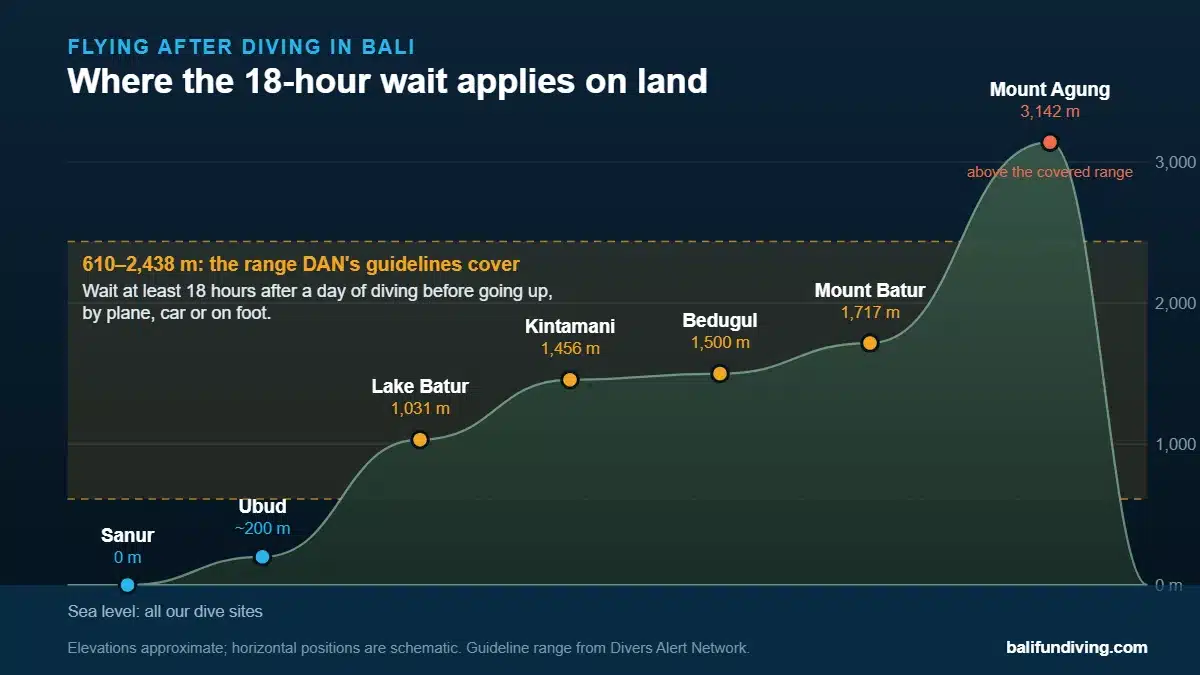
The waiting times above are not only for planes. The guidelines cover altitudes from about 610 to 2,400 metres, and DAN’s travel guidance points out that any ascent after diving, even by road, adds to decompression stress. Several of Bali’s most popular day trips are inside that range.
|
Place |
Approximate elevation |
Count it like a flight? |
|---|---|---|
|
Sanur, Kuta, Seminyak |
Near sea level |
No |
|
Ubud |
About 200 m |
No. It sits below the range the guidelines cover. |
|
Lake Batur |
About 1,030 m |
Yes |
|
Kintamani viewpoints |
About 1,450 m |
Yes |
|
Bedugul and the Botanic Garden |
About 1,250–1,500 m |
Yes |
|
Mount Batur sunrise trek |
1,717 m at the summit |
Yes |
|
Mount Agung |
3,142 m |
Yes, and it is higher than the guidelines cover. Climb it before you dive. |
The route matters as much as the stop. A drive across the highlands counts even if you never get out of the car.
The simplest fix is to change the order: go up the mountain first, then dive. Coming down from the highlands to dive at sea level does not create the same problem as going up after diving.
Customers ask us about this regularly. “can I go up to Kintamani after trying scuba for the first time?”, because they were worried about the altitude. They were right to ask. A Try Scuba day includes two dives, so the same 18 hours applies.
Two Itineraries That Keep the Gaps Right
|
Day |
5 days in Bali |
8 days with a volcano trek |
|---|---|---|
|
1 |
Arrive and rest |
Arrive and rest |
|
2 |
Dive Padang Bai or Tulamben (2 dives) |
Mount Batur sunrise trek, then back to the coast |
|
3 |
Dive Nusa Penida (3 dives) |
Beach or Ubud |
|
4 |
No diving: Ubud, beach, spa or shopping |
Dive Tulamben |
|
5 |
Fly home |
Dive Padang Bai |
|
6 |
Dive Nusa Penida |
|
|
7 |
No diving: Ubud, markets or a spa day |
|
|
8 |
Fly home |
Both plans leave a full day without diving before the flight, so a morning departure works as well as an evening one. A returning guest planned his own trip almost exactly this way: three diving days at Amed, Padang Bai and Nusa Penida, then what he called “a no fly day with some sightseeing”, and an evening flight home.
Diving on day 1 is possible. DAN notes that flying to a destination near sea level before diving poses virtually no risk, so the reason to wait is tiredness, not nitrogen. One couple landing in the late afternoon kept their first full day for the beach and started diving the day after.
Domestic Flights and Island Hopping
A domestic flight is still a flight. A short hop to Labuan Bajo or Lombok needs the same 18 hours as the long-haul flight home. If you are diving in Bali and then Komodo, treat the flight between them as your no-fly gap, and start diving again after you land.
Boats are different. A fast boat to Nusa Lembongan, the Gili Islands or Lombok stays at sea level, so it is not an altitude exposure.
If Something Feels Wrong Before You Fly
Do not board a flight with symptoms that could be decompression sickness, even if the 18 hours have passed. Signs include joint pain, numbness or tingling, weakness, dizziness, a skin rash, chest pain or difficulty breathing. Get a medical assessment first, contact DAN’s emergency line, and tell your dive center so we can help. Make sure your travel and dive insurance covers diving before you travel.
When you book a Fun Dive day trip or a course, include your departure time. Our team checks it against your dive days before confirming, as they did for the 1:05 am flight above. If you have been away from diving for a while, returning to scuba diving after a long break covers what to plan before your first dive back.
